The Beatles
.. environment. I suppose that means they’ve dated. Beatles’
songs not only define an era, (‘60s and early ‘70s), but they
are in turn defined by that era, as well as by their geographical and cultural
location. As a schoolboy I can remember practising Beatles’ songs at
Compton Tothill’s place and Compton’s father querying why we were
singing with Liverpool accents.
There’s also an underlying sadness that permeates nearly all Beatles’
songs, whether it be overtly in the lyrics or melody, or implied in the instrumentation
or arrangement, that perhaps reflects the comparatively austere times the
lads were brought up in post-war Britain, not to mention the songs they listened
to as they grew up. That verging-on-maudlin aspect appeals to my particular
sensibilities, as I suspect it appeals to a large section of my baby-boomer
contemporaries, but I sense that the major problem for today’s restless
listeners is that they simply haven’t got the sentimental attachment
that we baby boomers have and they lack the patience to cultivate it. In the
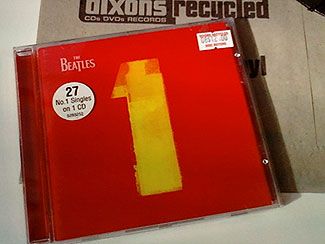
meantime I’ll take up Pete Dacy’s suggestion and get a copy of
‘1’ (a collection of twenty seven Beatles’ No. 1 hits released
in 2000 that in turn went to No. 1) and see whether the reaction is the same.
After I left school I went to Art School, (of course), and in my second year,
when I’d started playing with my first band, I began to take my crappy
portable record player along and proselytise on behalf of The Beatles –
and later The Kinks, The Who and The Rolling Stones etc. I certainly
devoured everything on record and in print about British bands and emulated
their fashions, courtesy of local couturier Borrie, (Les Sherlock), much to
the bemused tolerance of my fellow Art students – and insulting remarks shouted
from building sites. Following pop music and fashions in those days carried
the risk of attracting unwelcome attention.
Early on though, The Beatles set the standards by which all the other bands
were measured. I remember camping out overnight in Cathedral Square to be
amongst the first to get tickets for the first session of A Hard Day’s
Night, and I have to say I wasn’t disappointed. I was a fan.
Even after other bands and other musical fashions and styles started to dominate
the charts and take my attention, the Fab Four managed to surprise and delight
their fans – and confound their competition. I’ll be bold at this point
and nominate their 1967 single, All You Need Is Love, as the greatest
stroke in pop music history, particularly when the circumstances in which
the song was debuted are considered – i.e more or less performed live,
with an orchestra, on a world-wide satellite hook-up to 400 million people.
It was ground-breaking on every front; musically it had three time signatures,
including 7/4, and referenced La Marseillaise and Greensleeves
with fragments from Bach, Jeremiah Clarke and Glenn Miller. It had a simple
and powerful message calculated to defy language barriers – and, best
of all, even in black and white, you could see Mick Jagger going green.
When I met up with Jim Tomlin, The Chants’ first guitarist, I was astonished
to discover he didn’t share my enthusiasm for The Beatles; in fact,
he all but sneered when they were even mentioned. Jim was into jazz, and he
was much more comfortable when we grew out of The Beatles and lurched in the
direction of the blues as defined by the Stones, The Pretty Things, The Downliners
Sect and later, John Mayall and the Bluesbreakers.
I’ve mentioned liturgical music and the blues, but equally how do you
reconcile the Beatles and the blues? She’s A Woman has the
traditional blues architecture, (apart from the bridge), but it still sounds
like a Beatles’ tune – I sure as hell can’t hear John Lee Hooker
singing it.
People forget that The Beatles were once just another run-of-the-mill British
band, doing the same sort of covers that all the other bands of their day
were doing, including my band, The Chants. Check out the Live at the BBC
album (1994) which consists overwhelmingly of covers, with Chuck Berry being
over-represented, as he was in most of their contemporaries’ repertoires.
Oddly enough, I’m one of those who keep an eye out for instrumental
versions of Beatle tunes, jazz or otherwise, and I have to say that it doesn’t
always work out. The Lennon/McCartney canon doesn’t always translate,
particularly with musical styles that take liberties with the melodic structure,
and it really seems to be true that you’ve got to believe in
The Beatles if you want to cover them successfully. I was thrilled when we
released the No Thinking CD and Bobby Valentine rang me to say that
he doesn’t usually like anybody messing with Beatles’ stuff, but
he thought we’d done alright with our version of She’s A Woman.
I needn’t go into the particular chemistry between Lennon and McCartney,
which has been analysed to the point of absurdity, but it was unique and once
it was given its head, Lennon /McCartney compositions, (as performed by The
Beatles), dominated the Western world’s popular culture, as well as
infiltrating and subverting the Eastern bloc, ironically in very much the
way they feared it would.
Mike Daly said in his review of Living On A Volcano, ‘(Rudd’s)
vocals have a definite McCartney-ish feel’ so I’d not only have
to concede that they’ve been a personal influence, but that it’s
obvious. The Beatles may not fit in today’s landscape, and their influence
may only extend as far as a one-off song like Jet’s Look What You’ve
Done being described as Beatle-esque, but I can’t imagine my world
without them, and pop music would be several dimensions less interesting if
their contribution had never been.
*With all the hoo-hah
about the $200,000-odd spent on Melbourne’s ‘M’ symbol,
it’s interesting to reflect on how The Beatles’ logo came about.
Apparently Ludwig’s Ivor Arbiter drew a couple of sketches for Ringo
when he switched to Ludwig, and took the approved version to a sign writer,
Eddie Stokes, who used to do bass drum heads for Ivor, and, voila! One of
the world’s most famous logos was born.
Goddit! I’ll let you know how it goes with our picky crew..