Remembering Bill
For Bill, portraits were an occupational hazard and a source of income; workmanlike,
but oddly at variance with his other work, i.e. landscapes largely
empty of people. Had he painted only portraits he would have been a very minor
footnote in New Zealand art, but fortunately he spent nearly fifty years defining
the landscape of the Canterbury Plains in the South Island of New Zealand. In
the early works there was a concern with the marks that people make on the land;
the gravestones and frail wooden churches, but over time they transformed into
realistic abstractions of the hills and sky. He saw the underlying architecture
and mathematics of the hills, the sweep and detail of the clouds, and the occasional
frail scratches marks of civilisation that man left. He created a way of seeing
the Canterbury landscape in much the same way that we now see parts of Australia
through the paintings of Fred Williams.
And Bill could draw like an angel, something that Fred Williams could never
be accused of. This was embarrassing in Life Class, as I struggled to describe
part of the model’s anatomy in either pencil or charcoal. Bill would walk
up, cigarette fitfully smouldering, and with a few deft lines show what it should
actually look like. “It looks like this”, he would say, and of course
it did.
Bill was almost exactly thirty years my senior and died on the 23rd January
2000 at the age of eighty three, having suffered a long period of declining
health, not unrelated to a long history of nicotine and alcohol intake. His
ashes were scattered at Bruce Creek, depicted in one of his earlier paintings
with its edgy perspective and balanced off-centeredness. He was my painting
and drawing lecturer at Art School and we remained friends, corresponding erratically
and humorously over the years. He was immensely tolerant, though it took some
years for me to confess to him that I had been a party to blowing his letterbox
off the front wall.
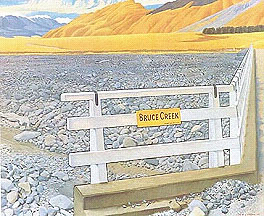
Bruce Creek
In appearance he somewhat resembled James Joyce camouflaged as a farmer; the
same longish, slightly overshot jaw, the rheumy eyes, swept back thinning hair
and stubbly moustache and goatee. He smoked roll-your-own cigarettes deftly
woven out of thin air with a twist and a lick; for most of his life one seemed
to be glued smouldering to his lip, creating the ongoing, but always unfulfilled
expectation, that one finally would cause him to scream with pain as it burnt
his upper lip. Like all his contemporaries, most of whom he out-lasted, he drank
whisky and beer to moderate excess. He never married for reasons that I have
forgotten, but the whisky drinking probably had something to do with it.
He was a fine painter who had an enormous artistic and personal influence upon
many people apart from myself, and yet hardly anybody outside of New Zealand
has heard of him – there was a small article in Art in America about twenty
years ago, and that would be it for international recognition.
He possessed a sardonic, impish anti-establishment wit, yet he still saw himself
as part of the long tradition of Western painting, and he would have been amused
and probably delighted to have a gallery wing named after him. He had two great
loves in art: the cool geometry in the painting of Piero Della Francesca, and
the contrapuntal mathematics and rhythms of J S Bach’s Canon and Fugues,
both of which shine through in his work.
There is an irony in his last ‘Plantation Series’ He detested pine
plantations and what they had done to large parts of the New Zealand landscape,
yet these works, with their strong, formal design and boldly painted rhythmic
surfaces, make their usurpation and occupation of the hills look quite splendid.
The sense of distance created by the diminishment of the shapes of the plantation,
and the colour recession as they roll towards the hazy horizon, are held back
by the geometry of composition, in turn based on the mathematical divisions
of the surface of the painting.
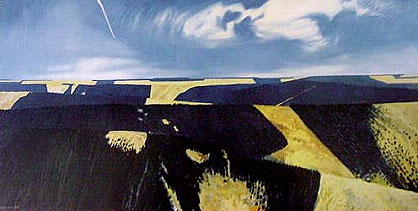
Plantation
He was a great writer of letters to his many friends so I’m going to quote
one that he sent me inside a copy of a book about him – you’ll have to
imagine the somewhat shaky hand-written italics.
Hi Hombres
Quite apart from the pleasure of your company recently, (hell I don’t
know how to finish that sentence so I shall start again). At last the bloody
book got published and apart from some original proof-reading, it seems to have
met with approval, although what the critics/theorists/educationist will think
remains undisclosed. If I haven’t made them dance with rage the book is
a failure. Poor souls (if they have one) they seem to suffer from a form of
dyslexia – everything has to be translated into words before they can
get it. To stand speechless in front of great painting and to have you mind
blown is normal procedure for the likes of us, ain’t it? The only word
permitted is “JESUS!!” or if agnostic “HOLY SMOKE!!”
Atheists are inclined to say “BY GUM!!” Pagans vouchsafe “AH
SO!!”.
However to get back to that first sentence it was fun great to see you again
and to meet Mary and Elizabeth so with my compliments herewith, somewhere in
this package you may discover a copy of said volume if you rummage sufficiently.
An adequate revenge huh So! Ah!
Also there’s horrendous weather in these part, winter seems upon us and
the grapes are still sour, my one hibiscus has come to a standstill and 2 stray
cats seem determined to move in before the frosts start. I jump up and down
and make go-away noises and they just sit there. Armageddon forsooth!
Must open another can of Speight’s and stop scribbling in case the censor
opens this lot
Cheers
Bill
For his sixtieth birthday I did a series of ‘Sutton Landscapes’
in pencil, trying to guess which way his painting might go, one of which I sent
him and which ended up in the Christchurch Gallery. Bill was responsible for
me coming to study further in Australia. He said it would improve the art of
both countries.
Dick’s Toolbox is written
by Mike’s brother, Richard Rudd.